menu
logopatek philippe certificate
THG_UWK_UR-300_Time-Quantum_KV

THE URWERK UR-300 TIME QUANTUM EXPLORES THE MECHANICS OF CHANGE

19 Oct 2026 · 14 min read

URWERK has long approached watchmaking through the mechanics of movement, drawing inspiration from planetary orbits and the relationship between time and space. With the introduction of the UR-300 Time Quantum, the independent Swiss watchmaker turns its attention towards an entirely different scale of existence. Inspired by quantum mechanics and the behaviour of subatomic particles, the latest creation from co-founders Felix Baumgartner and Martin Frei examines how seemingly independent mechanical components can interact, respond, and reorganise themselves as part of a single system.


The UR-300 Time Quantum introduces a new interpretation of URWERK's wandering-hour display, replacing the familiar orbital arrangement of rotating satellites with two interconnected hour modules that move in synchronised opposition. At the conclusion of each hour, the entire assembly undergoes an instantaneous mechanical reconfiguration, shifting into a new position to continue its measurement of time. This transition forms the central principle of the watch, translating the theoretical relationship between energy, matter, and movement into a physical expression of mechanical watchmaking.

From Planetary Orbits to Atomic Interactions
THG_UWK_UR-300_Time-Quantum_1
At the end of each hour, the T-frame rotates 72 degrees as the hour prisms simultaneously reposition to display the next hour

Since its founding in 1997, URWERK has developed a distinct approach to mechanical time indication, with its wandering-hour displays becoming a defining feature of the Manufacture's technical identity. Previous creations have explored the movement of celestial bodies through rotating satellite systems, while models such as the Opus V—developed alongside Harry Winston in 2005—and the UR-150 Scorpion in 2024 introduced retrograde mechanisms that punctuated the passage of time with a rapid return motion.


The UR-300 Time Quantum departs from this established arrangement. Its concept draws upon quantum mechanics, particularly the behaviour of particles and their interactions within systems of constantly shifting equilibrium. Central to this exploration is the idea of quantum entanglement, in which particles exhibit linked behaviour despite being separated by distance. URWERK interprets this principle through two mechanically connected structures that operate in reflected symmetry, with the movement of one directly influencing the position of the other.

THG_UWK_UR-300_Time-Quantum_2
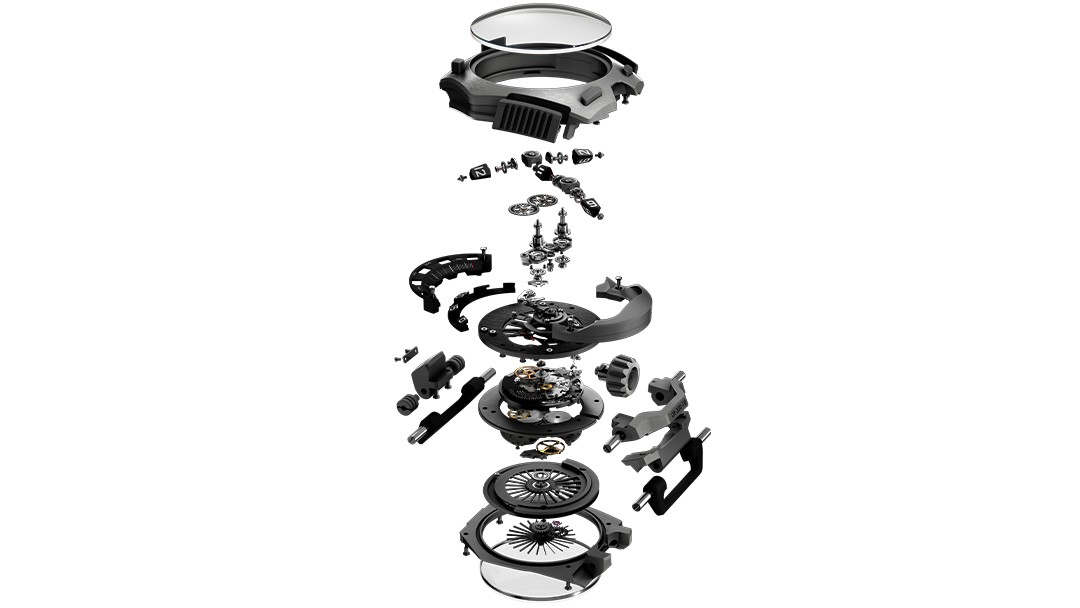
An exploded view illustrates the layered construction of the UR-300, from its rotating hour modules to the movement, winding system, and case components

For Felix Baumgartner, master watchmaker and co-founder of URWERK, the appeal of this concept lies in the relationship between energy and structural change. The introduction of energy into a system can disrupt its existing configuration, prompting its constituent elements to reorganise into a different state. In the UR-300, this principle becomes visible through the coordinated movement of the hour modules, which change their orientation at the precise moment one hour gives way to the next.


The result is a mechanism that retains URWERK's approach to unconventional time displays while introducing an entirely new sequence of mechanical interactions.

A New Interpretation of the Wandering Hour
THG_UWK_UR-300_Time-Quantum_3
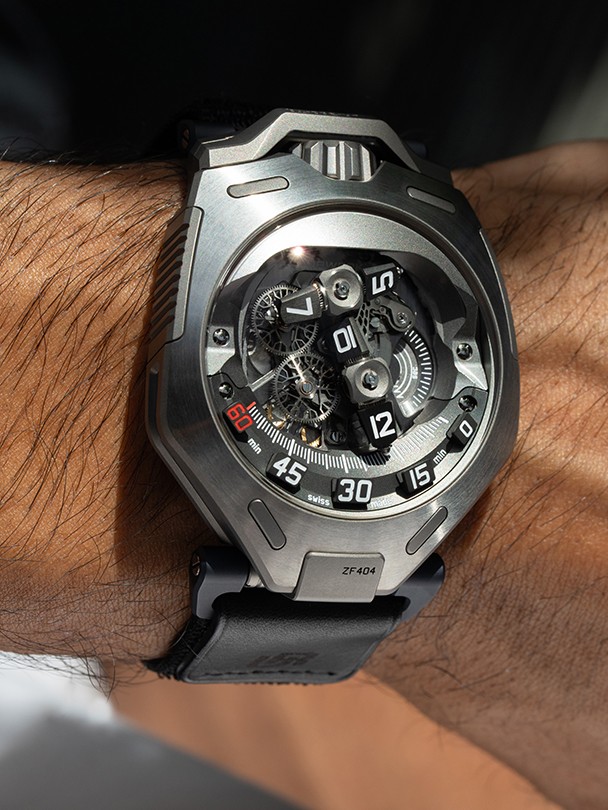
The UR-300 Titan presents a contrasting aesthetic, pairing its natural titanium finish with white hour numerals and red accents

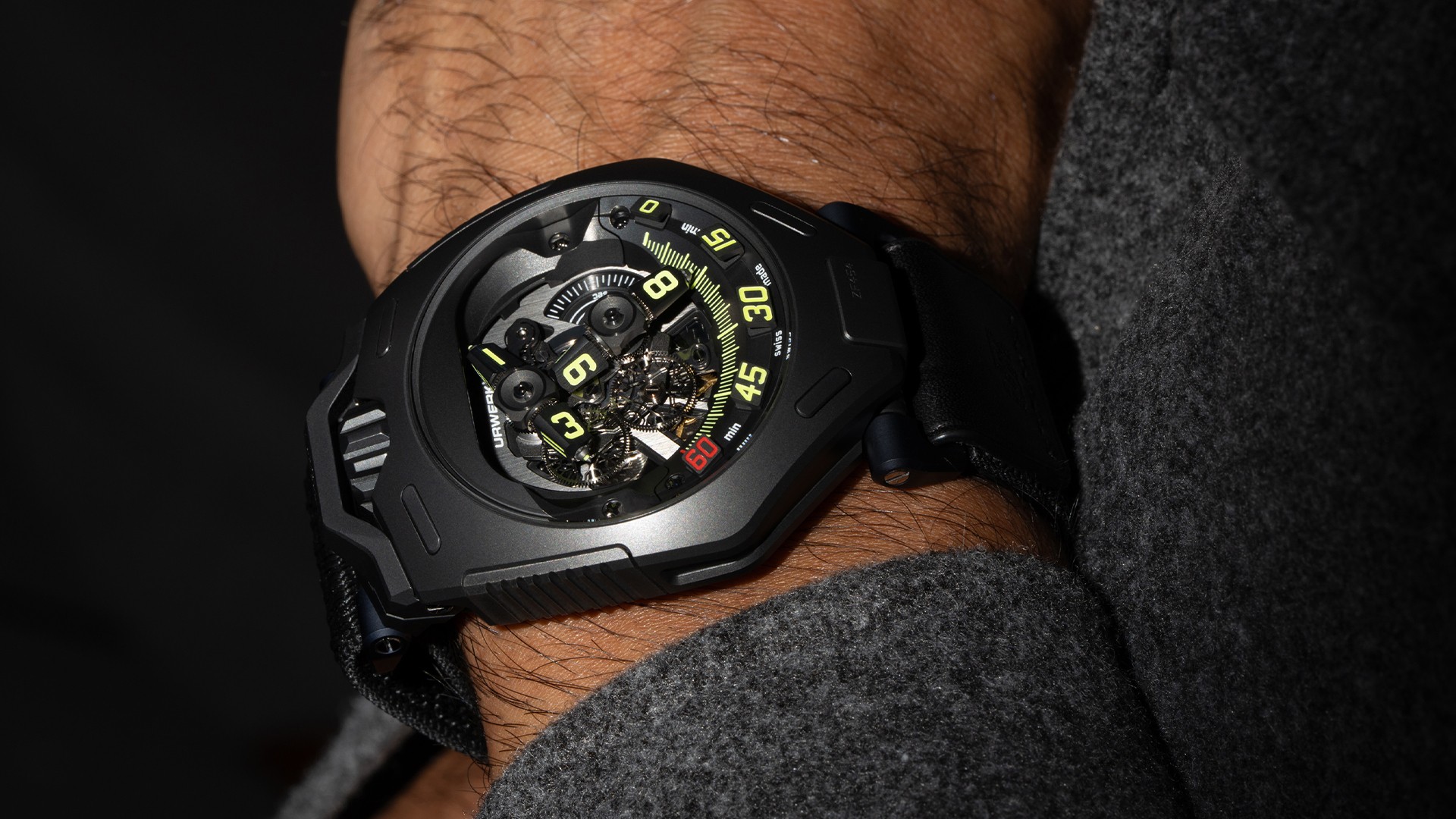
The UR-300 Time Quantum's central mechanism is constructed around two linear hour modules arranged perpendicularly to form a T-shaped structure, appropriately referred to as the T-frame. Each module features a three-sided hour prism at both ends, creating four prisms that collectively display the 12 hours of the clock.


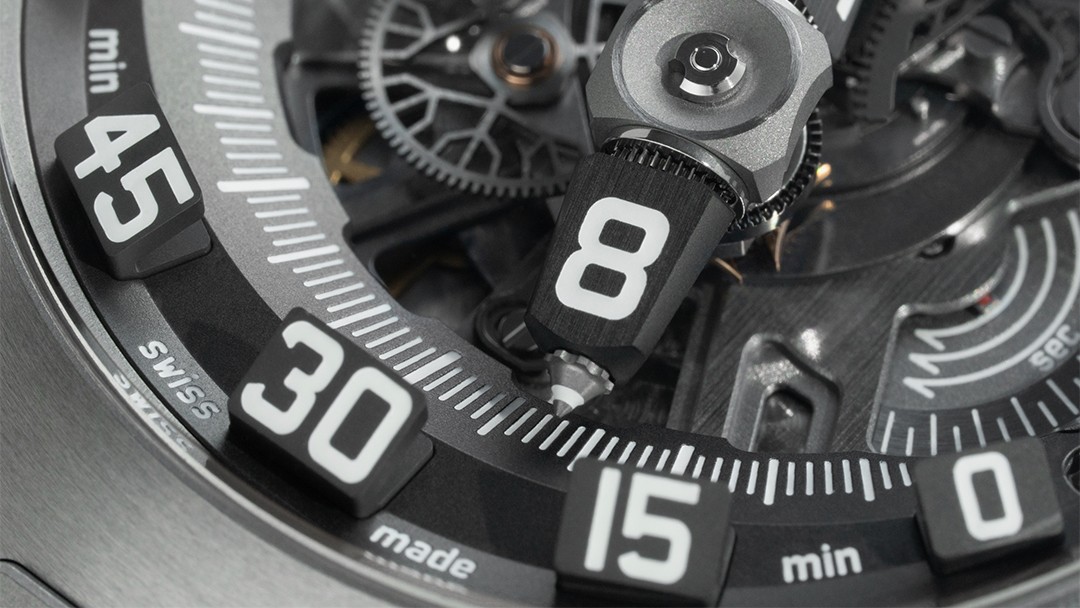
During normal operation, the prism positioned at the base of the T-frame indicates the current hour. As time progresses, this active prism travels along a 108-degree arc, following a minute scale marked from 0 to 60. The movement continues until the prism reaches the final minute marker, at which point the entire system undergoes a coordinated transition.

THG_UWK_UR-300_Time-Quantum_4
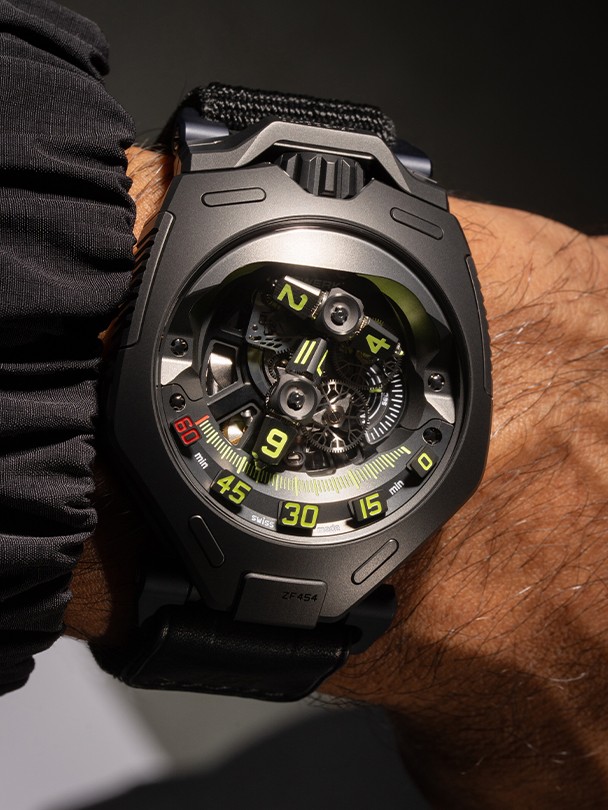
The UR-300 AlTiN's black NATO strap complements its darkened case, while the curved sapphire crystal offers an unobstructed view of the mechanism

Three mechanical actions occur simultaneously. First, the complete T-frame advances through a 72-degree rotation, positioning the next hour prism for its journey along the minute scale. At the same instant, the module previously forming the horizontal crossbar pivots around its midpoint to become the new vertical stem. The former stem rotates in the opposite direction, taking the place of the crossbar.


Simultaneously, all four hour prisms rotate on their respective axes, ensuring that the newly positioned prism displays the correct hour. The complete sequence occurs in a single instantaneous movement, with the components arriving at their new positions together.


Unlike the retrograde indications found in earlier URWERK creations, the UR-300 employs a forward-jumping mechanism. This arrangement eliminates the familiar sweeping return motion and instead produces an abrupt transition in which the entire display changes configuration. Each hour therefore begins with the mechanical system assuming a new arrangement, while maintaining the continuity of the wandering-hour indication.

Engineering an Instantaneous Transition
THG_UWK_UR-300_Time-Quantum_5
The active hour prism travels along a 108-degree arc, indicating the passage of minutes across the graduated scale

The technical challenge behind the UR-300 Time Quantum extends considerably beyond the geometry of its unusual display. Executing an instantaneous jump involving multiple components with relatively high inertia requires careful management of the energy that drives the mechanism.


The movement must accumulate sufficient force to initiate the complete transition, while ensuring that the release of energy does not generate excessive recoil or place unnecessary stress on the components. An imbalance could affect the positioning of the hour modules or introduce unwanted movement immediately after the jump.

THG_UWK_UR-300_Time-Quantum_6
Each double-ended hour module carries two three-sided prisms, with the four prisms collectively displaying all 12 hours

URWERK's engineers also had to determine the appropriate tolerances for each interacting component. The moving parts require enough clearance to accommodate the sudden acceleration that occurs at every hourly transition, yet they must remain sufficiently engaged to maintain mechanical efficiency and accurate positioning.


Further consideration was given to the number of components within the movement. Reducing unnecessary mechanical loads helps preserve the energy stored in the mainspring barrels, although additional safeguards remain necessary to ensure the watch can be adjusted in both forward and backward directions.


These considerations are particularly significant given the number of simultaneous actions involved in the UR-300's hourly transition. Every component must respond to the same release of energy, with the complete assembly settling into its next position without disrupting the movement's ongoing operation.

THG_UWK_UR-300_Time-Quantum_7
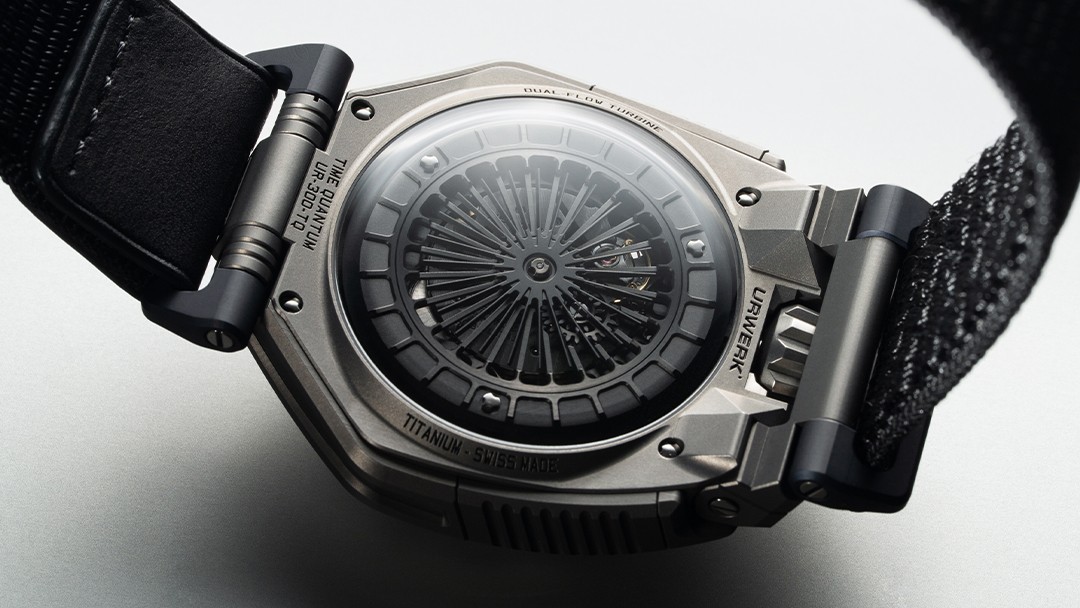
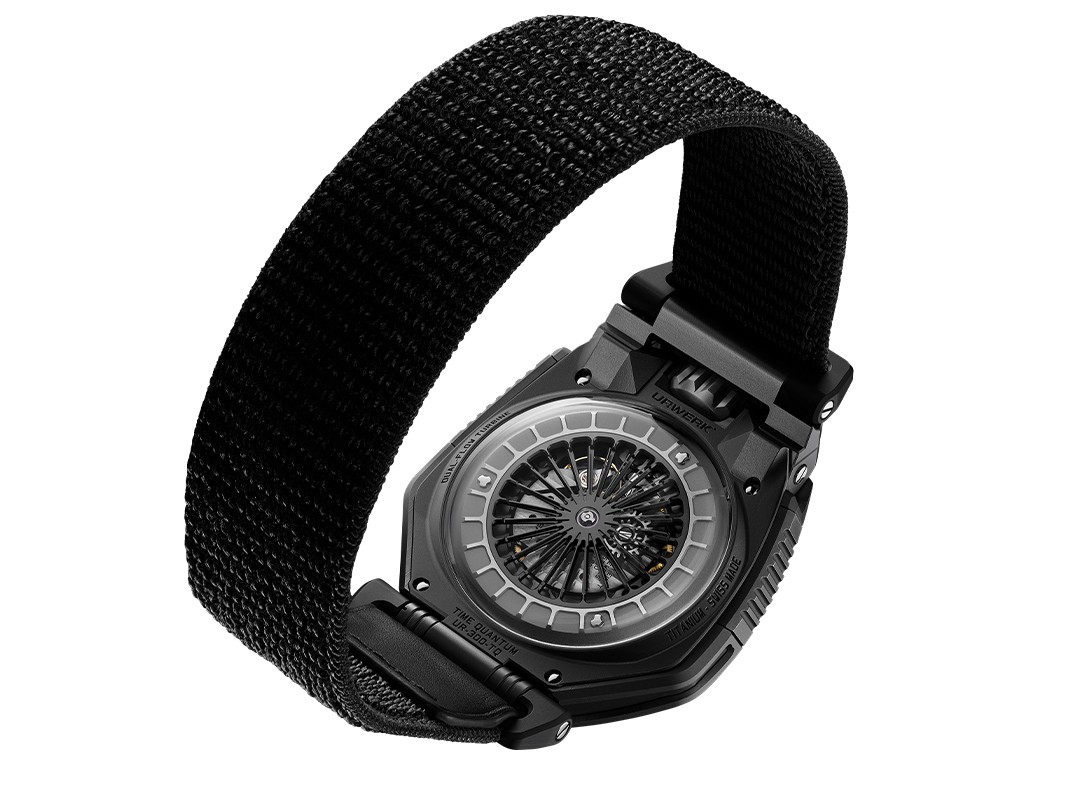
A closer view of the caseback highlights the turbine assembly beneath its radial grille, housed within the sculptural titanium construction

The resulting calibre UR-30.01V incorporates an automatic winding system regulated by URWERK's patented Dual Flow Turbines. Operating at a frequency of 4 Hz, or 28,800 vibrations per hour, the movement features 40 jewels, a Swiss lever escapement, and a double mainspring barrel providing a power reserve of 44 hours.


Its modular complication also incorporates a three-hand seconds indication, displaying three successive 20-second intervals across a 120-degree arc. The movement's construction draws upon materials including beryllium copper, brass, anodised aluminium, ARCAP, titanium, and LIGA-processed nickel, reflecting the different mechanical requirements of its individual components.

A Titanium Case Built Around the Mechanism
thg_uwk_ur-300_time-quantum_8
The AlTiN variation incorporates green numerals and minute markers, for greater contrast against its darkened case
thg_uwk_ur-300_time-quantum_10
The UR-300 Titan features a brushed titanium case with angular contours, a recessed crown, and an exposed mechanical display
thg_uwk_ur-300_time-quantum_9
Beneath the sapphire crystal, the interconnected hour modules form a T-shaped arrangement inspired by quantum entanglement
thg_uwk_ur-300_time-quantum_11
The caseback reveals URWERK's patented Dual Flow Turbines, which regulate the automatic winding system of the UR-30.01V

The UR-300 Time Quantum is housed in a Grade 5 titanium case measuring 45.2 mm across, 58.8 mm in length, and 18.25 mm in thickness. Its dimensions accommodate the complex movement architecture, while the broad sapphire crystal provides an unobstructed view of the interconnected hour modules and their mechanical transitions.


URWERK has developed two interpretations of the watch. The UR-300 Titan features a Grade 5 titanium case, while the UR-300 AlTiN employs the same material with a PE-CVD surface treatment. Both retain the sculptural case design and exposed mechanical display that characterise the collection, with the contrasting finishes offering different visual interpretations of the same construction.


The technical nature of the watch extends to its finishing, with circular and straight graining, sanding, Côtes de Genève, and chamfered and polished screwheads applied throughout the movement. Anti-reflective sapphire crystals protect the mechanism, while a NATO strap completes the watch.


Although the case retains familiar elements of URWERK's design language, the architecture beneath the crystal introduces a different visual rhythm. The T-frame places the mechanism's interconnected structures at the centre of the display, allowing their movement to communicate the passage of time directly. As the hour changes, the entire assembly briefly shifts before settling into its next configuration.

The Relationship Between Time and Perception
THG_UWK_UR-300_Time-Quantum_12
The UR-300 Time Quantum AlTiN on the wrist, featuring a Grade 5 titanium case with a PE-CVD surface treatment and contrasting green indications

The UR-300 Time Quantum represents a continuation of the ideas that have informed URWERK's work since its earliest creations. For Martin Frei, the Manufacture's co-founder and artistic director, the move from planetary motion towards atomic interactions reflects a change in perspective rather than a departure from the principles underlying the brand's previous designs.


Both scales involve trajectories, interactions, and forces that influence how objects move through space. In translating these relationships into watchmaking, the UR-300 explores how mechanical motion can make otherwise abstract concepts observable.


Its instantaneous hourly transition also introduces another consideration: the relationship between mechanical events and human perception. Although the movement's components undergo a complex sequence of rotations, their reconfiguration occurs faster than the eye can readily distinguish each individual action. The wearer therefore perceives a sudden change in the display, while the mechanical explanation for that change is revealed through closer observation.


This relationship between the visible indication and the intricate process behind it gives the UR-300 Time Quantum its particular character. The watch retains URWERK's longstanding interest in alternative methods of displaying time, while shifting the focus towards the coordinated behaviour of interconnected mechanisms. Through its T-frame architecture and instantaneous jumping display, the UR-300 offers a new perspective on how mechanical systems can represent the passage of an hour.

Share the story
1999 - 2026 © The Hour Glass Limited. All Rights Reserved.