menu
logopatek philippe certificate
THG_IAW26_Garrick_S8_Cover-Image

GARRICK WATCHES S8 REVEALS THE ART OF HAND-FINISHING

12 Nov 2026 · 11 min read

British independent watchmaker Garrick Watches introduces the S8, a new flagship model that places the techniques of traditional hand-finishing at the forefront of its design. Featuring a fully skeletonised movement housed within a 39mm case, the S8 strips mechanical watchmaking back to its most essential functions, displaying only the hours, minutes, and small seconds.


Founded by David Brailsford and Simon Michlmayr in Norfolk, England, Garrick Watches has established its approach around the work of individual watchmakers, each responsible for finishing and assembling a watch from beginning to end. The S8 extends this philosophy through its openworked architecture, exposing components and surfaces that would ordinarily remain concealed beneath a conventional dial.


Making its debut at IAMWATCH 2026 in Singapore, the S8 introduces a new manually wound calibre whose construction and finishing demand approximately eight weeks of work from a single watchmaker. It represents Garrick Watches' most labour-intensive undertaking to date, despite being among the mechanically simplest watches in its collection.


A Smaller Case, Considered from the Beginning
THG_IAW26_Garrick_S8_1
The Garrick S8 features a skeletonised S8 calibre housed within a 39mm stainless steel case

The development of the S8 can be traced to a recurring request from collectors familiar with Garrick's S3 collection. Both the S3 Mk2 and S3 Deadbeat Seconds were finalists at the Grand Prix d'Horlogerie de Genève (GPHG), drawing attention to the manufacture's approach to traditional English watchmaking. Their 42mm cases, however, prompted requests for a smaller alternative.


The S8 answers that demand with a case measuring 39mm in diameter and 8mm thick, proportions informed partly by Garrick's experience with its earlier S5. Interestingly, the S8 was initially conceived as a 40mm watch. During development, Garrick reconsidered its dimensions after examining how the absence of a conventional dial affected its visual proportions. The skeletonised construction draws the eye towards the outer edges of the case, giving the watch a greater visual presence than a similarly sized model with a closed dial.


Reducing the diameter by a millimetre allowed Garrick to retain the expansive view of the movement while refining how the watch sits on the wrist. The decision was made while the case remained in development, demonstrating how seemingly minor dimensional adjustments can influence the final composition.


Despite the smaller case, the S8 retains elements of the S3's visual identity. Most notably, the prominent wheel positioned near 1 o'clock on the S3 finds a counterpart in the S8's skeletonised ratchet wheel. Ordinarily a solid component responsible for transmitting motion during winding, the ratchet wheel has been opened to reveal the wheels beneath it. The dial aperture has also been maximised, ensuring that the reduced case dimensions do not restrict the view of the movement.

The Complexity of Removing Material
THG_IAW26_Garrick_S8_2
The S8's slender 8mm case profile is complemented by polished surfaces and a sapphire crystal

At the centre of the S8 is the newly developed, manually wound S8 calibre, operating at 21,600 vibrations per hour (3Hz) and providing approximately 60 hours of power reserve. Its skeletonised construction exposes the movement's mechanical architecture, with the hours and minutes indicated centrally and a small-seconds display positioned at 8 o'clock.


Removing material from the bridges and plates creates additional surfaces that require finishing. Each newly exposed edge must be bevelled and polished, while the inward-facing corners demand particular attention. On the S8, the bevels are cut entirely by hand, including those on the mainplate. The process begins with files to establish the required geometry, followed by progressively finer abrasives and polishing with diamond paste applied using a wooden peg.


The sharp internal angles are especially demanding. Where machine-operated cutting tools naturally leave rounded corners because of their rotating geometry, achieving a sharply defined inward point requires careful filing by hand.Garrick deliberately keeps the bevels narrow and shallow. Wider polished surfaces would reflect more light, potentially competing with the hands against the densely arranged components beneath them. The narrower bevels instead trace the contours of the movement, retaining definition without overwhelming the display.


Black polishing provides another source of contrast. Components are worked against a flat polishing surface using fine diamond paste until they attain a mirror finish. Depending on the direction of the light, these surfaces appear almost black before reflecting a bright flash when viewed from another angle. The remaining movement surfaces receive a finely frosted finish, establishing a matt background against which the polished edges and details become more apparent.

Eight Weeks at the Watchmaker's Bench
This watch is about our watchmakers. It's a window onto everything they've learned over the years, so people can see it for themselves rather than take our word for it.
David Brailsford, Garrick Watches co-founder
”

The S8's relatively straightforward indications conceal the extent of work required to produce its movement. During development, Garrick originally anticipated approximately four weeks for finishing and assembly. The process ultimately required more than eight weeks, roughly twice the time needed to complete an S3 Deadbeat Seconds. Much of this additional work arises from the skeletonised construction, which requires individual attention to the numerous exposed surfaces before the movement can be assembled.


In keeping with Garrick's established practice, each S8 is entrusted to one watchmaker throughout the process. This individual undertakes the finishing and plating of the components, assembles the movement, and manufactures the hands at the bench. The first two prototypes were built by watchmakers Stuart Smith and Alex Downing, whose work helped establish the finishing approach for the new calibre.

The Smallest Details Demand the Closest Attention
THG_IAW26_Garrick_S8_3
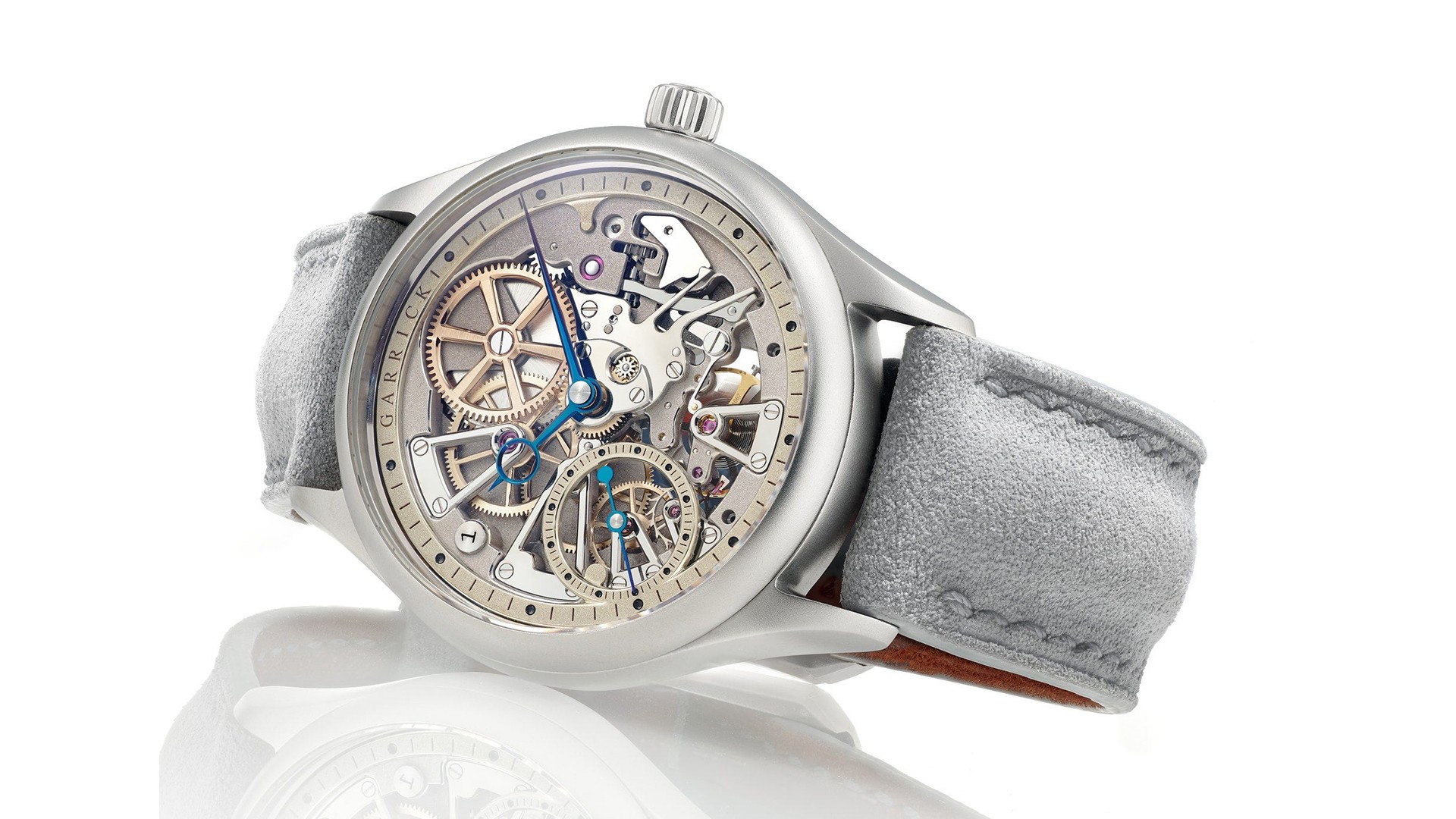
Hand-bevelled bridges, a skeletonised ratchet wheel, and heat-blued hands define the S8's openworked display

Beyond the exposed bridges and wheels, several of the S8's most intricate details are found around the periphery of its display. The chapter ring is fashioned from frosted German silver, an alloy of copper, nickel, and zinc. Its hour markers are individually engraved and filled with ink, a process complicated by the material's susceptibility to staining. On a conventional steel chapter ring, excess ink can be removed by spinning the component on a lathe. German silver presents a different challenge. Ink can permanently stain its surface, while the frosted finish draws pigment away from the engraved recesses.


To address this, Garrick fills each engraved marker individually using a needle under a microscope, allowing the watchmaker to control the application without marking the surrounding surface. A similarly meticulous approach is applied to the serial-number disc positioned near 11 o'clock. Each disc is turned on a lathe before being engraved, ink-filled, and hand-bevelled. It is subsequently fitted as a separate component within the openworked display.


The hands are also manufactured by the watchmaker responsible for the movement. Depending on the client's preference, they may be polished, heat-blued, or heat-purpled. The latter treatments derive their colour from the controlled heating of steel rather than applied pigments. As the temperature increases, a thin oxide layer develops across the metal, producing successive colour changes. Achieving the intended shade depends on stopping the heating process at the appropriate moment, particularly when producing purple hands, as the metal transitions towards blue.

An Individual Approach to Finishing
THG_IAW26_Garrick_S8_4
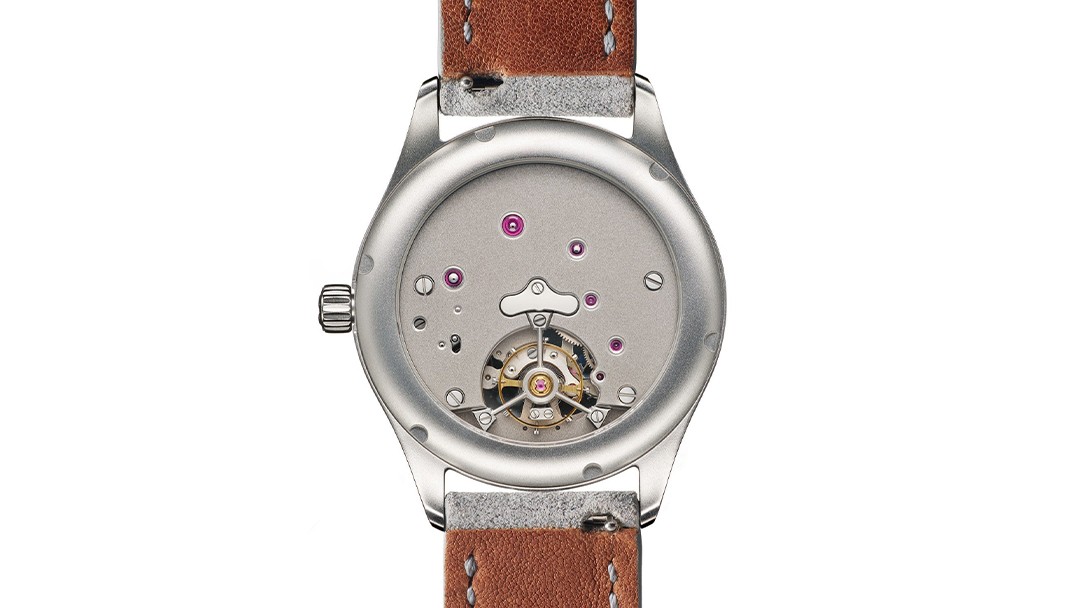
The exhibition caseback reveals the movement's frosted finishing and exposed balance assembly

As with other Garrick watches, the S8 is built to order, providing clients with considerable freedom over its final appearance. The movement can be finished in silver or dark grey rhodium, yellow gold, or pink gold, with contrasting options available for the wheels and balance. These combinations allow the exposed mechanical architecture to take on different visual characteristics while retaining the same underlying construction.


The 39mm case is produced in 904L stainless steel, with polished or frosted finishes available. Precious-metal cases can also be requested. A sapphire crystal with anti-reflective coating protects the openworked display, while an exhibition caseback provides an additional view of the manually wound calibre. The absence of an automatic winding rotor leaves the movement unobstructed from the rear.


Both the movement and case are deliberately left without decorative engraving, allowing the hand-finishing to define their appearance. The caseback also remains available for a personal inscription chosen by the owner. The S8's construction is completed by a choice of handmade steel hands, a pin buckle corresponding to the selected case material, and water resistance rated to 100m.

A New Chapter for Garrick at IAMWATCH 2026


The Garrick S8 makes its debut at IAMWATCH 2026, held at The Singapore EDITION from 12 to 15 November 2026. Its presentation offers an opportunity to examine the finishing techniques that have shaped the model's development. The narrow bevels, sharp internal angles, and black-polished surfaces are particularly revealing under changing light, where their contrasting textures become more apparent.


For Garrick, the S8 also reflects the evolution of its approach to independent watchmaking. The manufacture has retained the direct involvement of an individual watchmaker while developing a new movement whose exposed construction places greater demands on traditional finishing techniques.


The result is a watch whose mechanical simplicity makes the work behind its creation unusually visible. Every polished edge, engraved marker, and individually finished component contributes to an understanding of the hours spent at the bench. With the S8, Garrick has produced a watch that presents the skills of its makers through the movement itself, allowing the quality of their work to be examined from both sides of the case.

Share the story
1999 - 2026 © The Hour Glass Limited. All Rights Reserved.